Severe (Stage III–IV) Endometriosis: Is IVF Still an Option?
What does stage III–IV endometriosis mean?
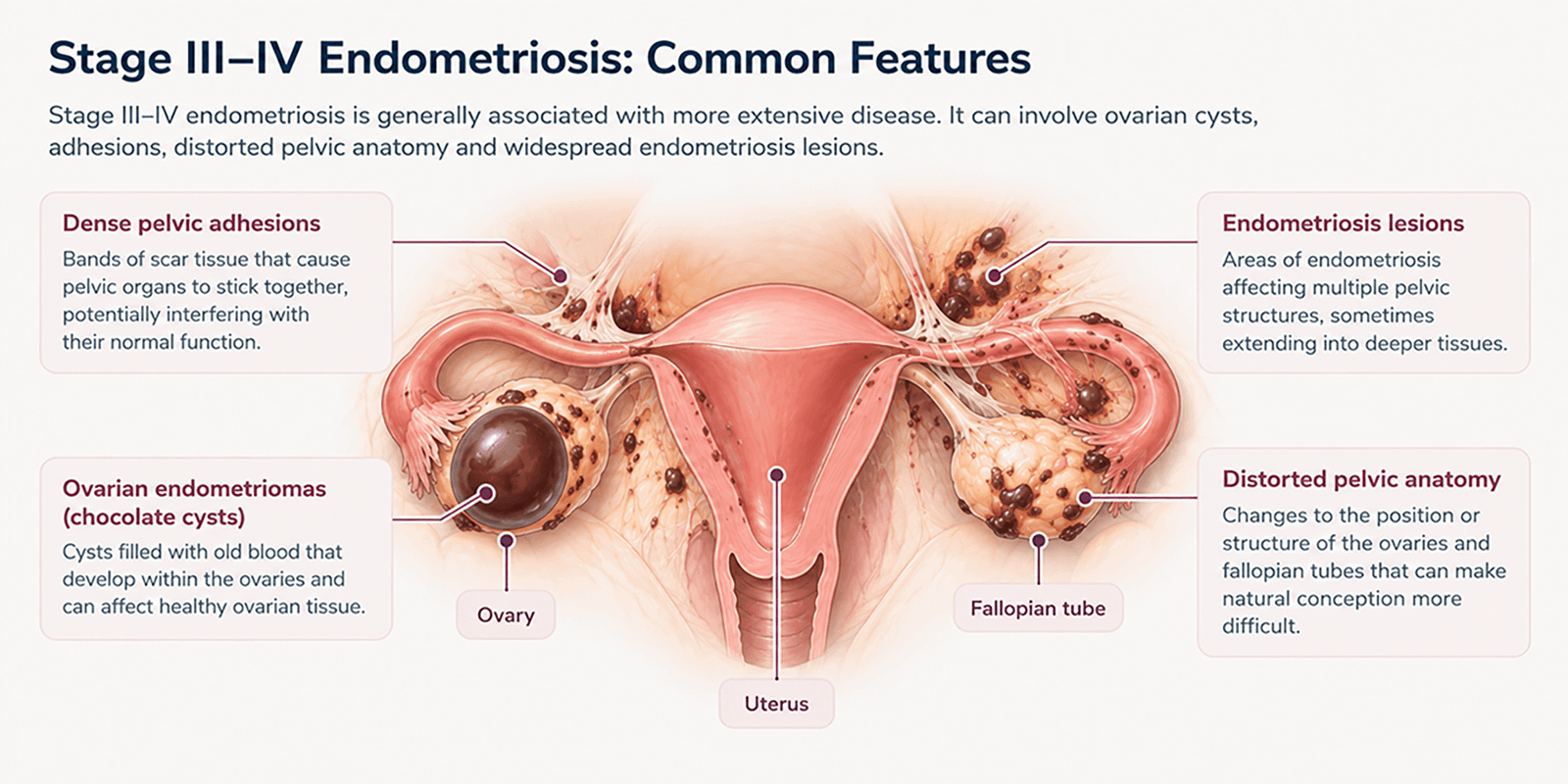
Illustration showing how stage III–IV endometriosis can affect the reproductive organs, including ovarian endometriomas, pelvic adhesions and endometriosis lesions.
Endometriosis occurs when tissue similar to the lining of the uterus grows outside the uterus, commonly affecting the ovaries, fallopian tubes and surrounding pelvic structures.
The condition is classified into four stages, from minimal (Stage I) to severe (Stage IV), based on the location and extent of endometriosis lesions, ovarian cysts and scar tissue (adhesions).
Moderate to severe endometriosis generally involves more extensive disease, which can include:
- Ovarian endometriomas (chocolate cysts) – Cysts containing old blood that develop within the ovaries and can affect healthy ovarian tissue.
- Dense pelvic adhesions – Bands of scar tissue that cause pelvic organs to stick together, potentially interfering with their normal function.
- Distorted pelvic anatomy – Changes to the normal position of the ovaries and fallopian tubes that can make natural conception more difficult.
- Extensive endometriosis lesions – Disease affecting multiple areas of the pelvis, sometimes involving deeper tissues.
Importantly, the stage of endometriosis does not necessarily reflect the severity of symptoms or a woman’s ability to conceive. Some women with advanced disease experience relatively little pain, while others with early-stage disease have significant symptoms.
Similarly, having Stage III–IV endometriosis does not automatically mean infertility. Its impact on fertility depends on factors such as ovarian reserve, fallopian tube function and the extent of pelvic adhesions.
How does severe endometriosis affect fertility?
Severe endometriosis can make pregnancy harder in several ways, though how much it affects each woman varies.
| Blocked or distorted fallopian tubes | Pelvic adhesions can pull the fallopian tubes out of their normal position or interfere with their function, making it harder for the egg and sperm to meet naturally. |
| Reduced ovarian reserve | Ovarian endometriomas can affect healthy ovarian tissue and are associated with reduced ovarian reserve. Previous surgery to remove these cysts can also reduce the number of eggs remaining. |
| Inflammation within the pelvis | Endometriosis creates an inflammatory environment that can interfere with normal reproductive processes, potentially affecting egg development, fertilisation and embryo implantation. |
Some women with stage III–IV endometriosis still conceive naturally, but many need help. IVF is often recommended at this stage because it works around the main obstacles: eggs are collected directly from the ovaries and fertilised in the lab, so blocked tubes and pelvic adhesions no longer stand in the way. Age and egg reserve also matter here. When time is a factor, moving to IVF sooner can make a real difference.
How is IVF different for women with severe endometriosis?
While the basic IVF process remains the same, treating women with stage III–IV endometriosis can be more complex than a routine IVF cycle. This is because the condition can affect ovarian reserve, alter pelvic anatomy and make certain procedures more challenging.
For fertility specialists managing complex endometriosis cases, the goal is not simply to retrieve eggs and create embryos. It is also to consider how the underlying condition affects treatment, whether intervention is needed beforehand and how to preserve ovarian function throughout the process.
Related reading: In-Vitro Fertilisation (IVF)
- Assessing ovarian reserve before treatment
Women with severe endometriosis, especially those with ovarian endometriomas or a history of ovarian surgery, can have reduced ovarian reserve.Before starting IVF, the fertility specialist typically assesses:
- Anti-Müllerian hormone (AMH) levels to estimate ovarian reserve and help predict the response to ovarian stimulation.
- Antral follicle count (AFC) through ultrasound to assess the number of small follicles within the ovaries.
- Previous surgical history, including whether ovarian cysts have been removed and how much healthy ovarian tissue remains.
These findings help guide treatment planning, including medication dosing and expectations for egg retrieval.
- Tailoring ovarian stimulation
During IVF, fertility medications stimulate the ovaries to develop multiple follicles. However, women with endometriosis-related ovarian damage or reduced ovarian reserve can respond differently to stimulation.
Women with reduced egg reserve may need higher doses or a different protocol, while others respond normally. Dr Tan adjusts treatment based on how the ovaries respond during monitoring, aiming for a good number of mature eggs without overstimulating.
- Planning egg retrieval around endometriomas and adhesions
Egg retrieval can be more technically challenging when large endometriomas or dense pelvic adhesions affect the position and accessibility of the ovaries.
The fertility specialist must carefully assess the ovarian anatomy using ultrasound and plan a safe route to retrieve eggs while avoiding puncturing endometriomas where possible.
In some cases, extensive adhesions or ovarian positioning can limit access to certain follicles. This makes pre-treatment assessment and procedural planning especially important.
- Deciding whether to treat endometriosis before IVF
Not every woman needs surgery before IVF, and in some cases, it can do more harm than good. We cover this decision in detail below.
- Planning embryo transfer
Following egg retrieval and fertilisation, the specialist also considers whether a fresh embryo transfer or frozen embryo transfer is more appropriate.
For selected patients, hormonal treatment before embryo transfer may also be considered. However, prolonged hormonal suppression is not routinely recommended solely to improve IVF success rates in women with endometriosis, as the evidence of benefit remains uncertain.
Should you have endometriosis surgery before IVF?
Surgery is not always necessary before IVF, even for women with stage III–IV endometriosis. While removing endometriosis can help relieve symptoms and address certain complications, surgery involving the ovaries can also reduce ovarian reserve.
Your fertility specialist may recommend surgery first if you have:
- Severe pelvic pain – Pain that has not responded adequately to other treatments.
- Large or complex endometriomas – Ovarian cysts that cause symptoms, have concerning features or obstruct egg retrieval.
- Hydrosalpinx (fluid-filled fallopian tubes) – Fluid trapped in a damaged fallopian tube can reduce IVF success rates and may require surgical treatment before embryo transfer.
- Deep endometriosis – Endometriosis affecting the bowel, bladder or ureters that requires surgical treatment.
On the other hand, proceeding directly to IVF may be preferable for women with reduced ovarian reserve, previous ovarian surgery or age-related fertility concerns.
In short, surgery makes sense when there’s a clear reason for it. When time and egg reserve are the bigger concern, going straight to IVF is often the better choice.
What are my chances of success with IVF?
Many women with severe endometriosis conceive through IVF, though success rates per cycle tend to be somewhat lower than in women without the condition [1, 2]. This is mainly because fewer eggs are collected, while the embryos themselves are often of similar quality [3]. As a result, some women may need more than one cycle.
Your chances depend less on your stage and more on your age, egg reserve and any previous ovarian surgery. A fertility assessment gives you a realistic picture before you start.
Having endometriosis doesn’t always mean you can’t conceive
A diagnosis of severe endometriosis can make the journey to pregnancy more challenging, but it does not mean that having a child is out of reach. With appropriate treatment, many women with stage III–IV endometriosis can still conceive, whether naturally or through assisted reproductive techniques such as IVF.
With experience in managing complex endometriosis cases and performing IVF for women with endometriosis-related infertility, Dr Tan Heng Hao has successfully helped patients with endometriosis conceive through assisted reproductive treatment. His expertise in both endometriosis management and fertility care allows him to develop individualised treatment plans that address the condition while working towards each patient’s pregnancy goals.
If you have severe endometriosis and are planning for pregnancy, schedule a consultation with us to discuss your fertility assessment and available treatment options.
Frequently Asked Questions
Can I get pregnant naturally with stage 4 endometriosis?
Yes, natural conception is still possible with stage 4 endometriosis. However, extensive adhesions, ovarian cysts and damage to the fallopian tubes can make pregnancy more difficult. Your chances depend on factors such as age, ovarian reserve and whether the reproductive organs can function normally.
Does endometriosis affect egg quality?
Endometriosis can create an inflammatory environment that potentially affects egg development and quality. However, this does not mean that all women with endometriosis have poor-quality eggs. Age remains one of the most important factors affecting egg quality.
Will IVF make my endometriosis worse?
IVF involves hormonal stimulation that temporarily increases oestrogen levels, which can aggravate endometriosis symptoms in some women. However, current evidence does not suggest that IVF consistently causes long-term progression of the condition. Your fertility specialist can monitor your symptoms and adjust treatment where appropriate.
Should I freeze my eggs if I have severe endometriosis?
Egg freezing can be considered for women with severe endometriosis who wish to preserve their fertility, especially if they are not ready for pregnancy or may require ovarian surgery. The decision depends on age, ovarian reserve, the extent of the disease and future reproductive plans. Egg freezing can provide another opportunity for pregnancy later, but it does not guarantee success.
References:
- Harb HM, et al. The effect of endometriosis on in vitro fertilisation outcome: a systematic review and meta-analysis. BJOG. 2013;120(11):1308–1320.
- Hamdan M, et al. Influence of endometriosis on assisted reproductive technology outcomes: a systematic review and meta-analysis. Obstet Gynecol. 2015;125(1):79–88.
- Endometriosis lowers the cumulative live birth rates in IVF by decreasing the number of embryos but not their quality. J Clin Med. 2020;9(8):2478. doi:10.3390/jcm9082478